



Language:
English


|
|
|
|
2
30'
13
Moderate in-game text
|
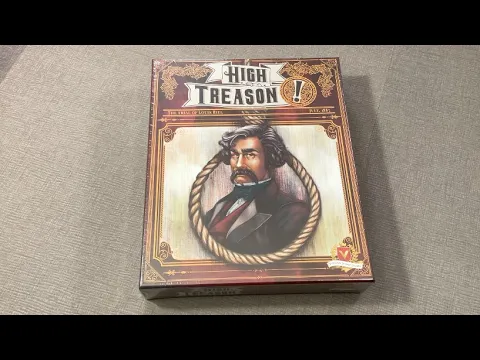
High Treason: The Trial of Louis Riel - Third Edition
Publisher: Victory Point Games
 Do you want to sell your copy of this game?

Use our marketplace utrade!
High Treason: The Trial of Louis Riel - Third Edition
Contact us
Share on
 Available in an external warehouse.
Shipping in about 3/7 days
-15%
36,54€
Sale Price
IT
4,49€
PICTURES ON BGG
These photos are the property of boardgamegeek.com and do not refer specifically to the edition on this page.


 Description
Now YOU enter the courtroom during five fateful days of July, 1885, when the future of a country hung in the balance, and the defendant, Louis Riel, faced hanging on a charge of treason. Canada’s westward expansion was very different than that of the United States. In the U.S., conflict in the westward movement was between the White Man and the Native Indian, and a common language united U.S. settlers. Language, however, has divided Canada ever since General Wolfe united the country by arms at the Plains of Abraham. Canada’s settlers pushed westward, led by fur-traders and trappers who were predominately French Catholic. These pioneers intermarried with the Native Indians, producing a new race and a new culture – the Métis. When the Canadian government made treaties with Native Indians, the Métis, being neither Native nor White, did not receive any comparable consideration. Wanting to protect their rights against the remote Anglo-Protestant government in eastern Canada, resentment grew into rebellion in Manitoba's Red River Valley in 1869. Louis Riel led this resistance and forced the government into compromise, resulting in the Manitoba Act. Due to his participation in the rebellion and in the execution of English Protestant, Thomas Scott, Riel himself was forced to flee to the United States. While residing there, Riel obtained American citizenship. When trouble between the Métis and the government occurred further west, in Saskatchewan, the Métis recalled their former savior to lead them. Louis Riel and Gabriel Dumont, a local Métis leader, initially worked toward a peaceful solution for their grievances. However, this movement eventually grew into a resistance, known as the North West Resistance. The Conservative government in Ottawa amassed a military force to crush it, and finally did at the Battle of Batoche, 9 – 12 May, 1885. While Gabriel Dumont fled to the United States after the battle; Louis Riel was tried and hanged for High Treason in Canada. There are many reasons why the first Riel resistance succeeded and the second failed. The westward expansion of the railroad allowed the federal government to deploy superior forces rapidly to the field. Riel himself embraced unorthodox religious views – views that alienated the Catholic Church and its devout supporters who were the key to his first resistance’s success.
 Additional information
| Mechanics: | Simulation Hand Management |
| Categories: | Card Games Deduction Educational |
| Alternative names: | |
| BARCODE: | 810082831245 |
| This was seen 640 times | |
Description
Now YOU enter the courtroom during five fateful days of July, 1885, when the future of a country hung in the balance, and the defendant, Louis Riel, faced hanging on a charge of treason. Canada’s westward expansion was very different than that of the United States. In the U.S., conflict in the westward movement was between the White Man and the Native Indian, and a common language united U.S. settlers. Language, however, has divided Canada ever since General Wolfe united the country by arms at the Plains of Abraham. Canada’s settlers pushed westward, led by fur-traders and trappers who were predominately French Catholic. These pioneers intermarried with the Native Indians, producing a new race and a new culture – the Métis. When the Canadian government made treaties with Native Indians, the Métis, being neither Native nor White, did not receive any comparable consideration. Wanting to protect their rights against the remote Anglo-Protestant government in eastern Canada, resentment grew into rebellion in Manitoba's Red River Valley in 1869. Louis Riel led this resistance and forced the government into compromise, resulting in the Manitoba Act. Due to his participation in the rebellion and in the execution of English Protestant, Thomas Scott, Riel himself was forced to flee to the United States. While residing there, Riel obtained American citizenship. When trouble between the Métis and the government occurred further west, in Saskatchewan, the Métis recalled their former savior to lead them. Louis Riel and Gabriel Dumont, a local Métis leader, initially worked toward a peaceful solution for their grievances. However, this movement eventually grew into a resistance, known as the North West Resistance. The Conservative government in Ottawa amassed a military force to crush it, and finally did at the Battle of Batoche, 9 – 12 May, 1885. While Gabriel Dumont fled to the United States after the battle; Louis Riel was tried and hanged for High Treason in Canada. There are many reasons why the first Riel resistance succeeded and the second failed. The westward expansion of the railroad allowed the federal government to deploy superior forces rapidly to the field. Riel himself embraced unorthodox religious views – views that alienated the Catholic Church and its devout supporters who were the key to his first resistance’s success.
Additional information
| Mechanics: | Simulation Hand Management |
| Categories: | Card Games Deduction Educational |
| Alternative names: | |
| BARCODE: | 810082831245 |
| This was seen 640 times | |

CAUTION! Not suitable for children under 3 years of age. It contains small parts which could be swallowed or inhaled.