


 (+39) 320 073 4588
 CONTACT US VIA EMAIL

-
Menu

-
Ranks

-
Boardgame

-
RPG

-
Party

-
CG

-
Accessories

-
Lego

-
Book

-
Comics



|
|
|

1-2
30'
12
Some necessary text
|
Second World War at Sea: Spice Islands
Publisher: Avalanche Press Ltd.
 Do you want to sell your copy of this game?

Use our marketplace utrade!
Second World War at Sea: Spice Islands
Contact us
Share on
 The game can be ordered, but we do not have any information about it.
Retail price:
19,99€
18,90€
IT
4,49€
PICTURES ON BGG
These photos are the property of boardgamegeek.com and do not refer specifically to the edition on this page.


 Description
From the Avalanche Press website:
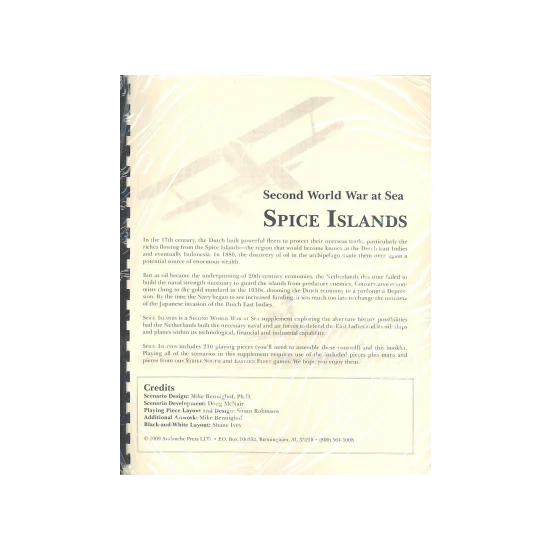
In the 17th century, the Dutch built powerful fleets to protect their overseas trade, particularly the riches flowing from the Spice Islands — the region that would become known as the Dutch East Indies and eventually Indonesia. In 1880, the discovery of oil in the archipelago made them once again a potential source of enormous wealth.
But as oil became the underpinning of 20th century economies, the Netherlands this time failed to build the naval strength necessary to guard the islands from predatory enemies. Conservative economists clung to the gold standard in the 1930s, dooming the Dutch economy to a prolonged Depression. By the time the Navy began to see increased funding, it was much too late to change the outcome of the Japanese invasion of the Dutch East Indies.
In the 1930s, Dutch shipyards stood at the leading edge of naval technology: Dutch submarines first deployed the schnorkel breathing device, for example, and Dutch warships boasted the sophisticated Hazemeyer fire control system that would be enthusiastically copied by the Royal Navy and others. The Netherlands had the means to create a large and modern fleet, and the oil wealth of Borneo and Sumatra provided the motive. But by seeing deficits as a more lethal enemy than the Axis, the government doomed both the home country and the colonies to defeat and occupation.
Spice Islands is a Second World War at Sea supplement exploring the alternate history possibilities had the Netherlands built the necessary naval and air forces to defend the East Indies and its oil: ships and planes within its financial and industrial capability. The supplement includes ten scenarios, or separate game situations, based on battles that might have been waged by the Royal Netherlands Navy against the Japanese. The pieces represent modernized versions of the dreadnought battleships planned but not completed, and some of those planned or discussed but never built. This module is not playable by itself, but requires ownership of Strike South to play most of the scenarios and Midway to enjoy all of them."
Spice Islands was originally sold exclusively via pdf download. Starting in 2011, it was made available as a printed and spiral-bound booklet with die-cut counters.
There are 210 counters, 70 long "ship" units, and 140 smaller ship, aircraft and fleet / base units.
 Additional information
| Mechanics: | |
| Categories: | Expansion for base-game Nautical War |
| Alternative names: | |
| BARCODE: | ????????? |
| This was seen 548 times | |
Description
From the Avalanche Press website:
In the 17th century, the Dutch built powerful fleets to protect their overseas trade, particularly the riches flowing from the Spice Islands — the region that would become known as the Dutch East Indies and eventually Indonesia. In 1880, the discovery of oil in the archipelago made them once again a potential source of enormous wealth.
But as oil became the underpinning of 20th century economies, the Netherlands this time failed to build the naval strength necessary to guard the islands from predatory enemies. Conservative economists clung to the gold standard in the 1930s, dooming the Dutch economy to a prolonged Depression. By the time the Navy began to see increased funding, it was much too late to change the outcome of the Japanese invasion of the Dutch East Indies.
In the 1930s, Dutch shipyards stood at the leading edge of naval technology: Dutch submarines first deployed the schnorkel breathing device, for example, and Dutch warships boasted the sophisticated Hazemeyer fire control system that would be enthusiastically copied by the Royal Navy and others. The Netherlands had the means to create a large and modern fleet, and the oil wealth of Borneo and Sumatra provided the motive. But by seeing deficits as a more lethal enemy than the Axis, the government doomed both the home country and the colonies to defeat and occupation.
Spice Islands is a Second World War at Sea supplement exploring the alternate history possibilities had the Netherlands built the necessary naval and air forces to defend the East Indies and its oil: ships and planes within its financial and industrial capability. The supplement includes ten scenarios, or separate game situations, based on battles that might have been waged by the Royal Netherlands Navy against the Japanese. The pieces represent modernized versions of the dreadnought battleships planned but not completed, and some of those planned or discussed but never built. This module is not playable by itself, but requires ownership of Strike South to play most of the scenarios and Midway to enjoy all of them."
Spice Islands was originally sold exclusively via pdf download. Starting in 2011, it was made available as a printed and spiral-bound booklet with die-cut counters.
There are 210 counters, 70 long "ship" units, and 140 smaller ship, aircraft and fleet / base units.
Additional information
| Mechanics: | |
| Categories: | Expansion for base-game Nautical War |
| Alternative names: | |
| BARCODE: | ????????? |
| This was seen 548 times | |

CAUTION! Not suitable for children under 3 years of age. It contains small parts which could be swallowed or inhaled.