

-
Wählen Sie die Sprache der Website
-
 Deutsch
DE
Deutsch
DE
-
 English
EN
English
EN
-
 Français
FR
Français
FR
-
 Español
ES
Español
ES
-
 Italiano
IT
Italiano
IT
-
 Polski
PL
Polski
PL
-
 Português
PT
Português
PT
-
Land, in das versendet werden soll


-
Wählen Sie die Sprache der Website
-
Deutsch
DE
-
English
EN
-
Français
FR
-
Español
ES
-
Italiano
IT
-
Polski
PL
-
Português
PT
-
Land, in das versendet werden soll


 (+39) 320 073 4588
 KONTAKTIEREN SIE UNS PER E-MAIL
-
Wählen Sie die Sprache der Website
-
Deutsch
DE
-
English
EN
-
Français
FR
-
Español
ES
-
Italiano
IT
-
Polski
PL
-
Português
PT
-
Land, in das versendet werden soll

-
Menue

-
Ränge

-
Brettspiele

-
Rollenspiel

-
Partyspiele

-
CG

-
Zubehör

-
Lego

-
Buecher

-
Comics



|
|
|

2-6
45'
8
Kein notwendiger Text im Spiel
|
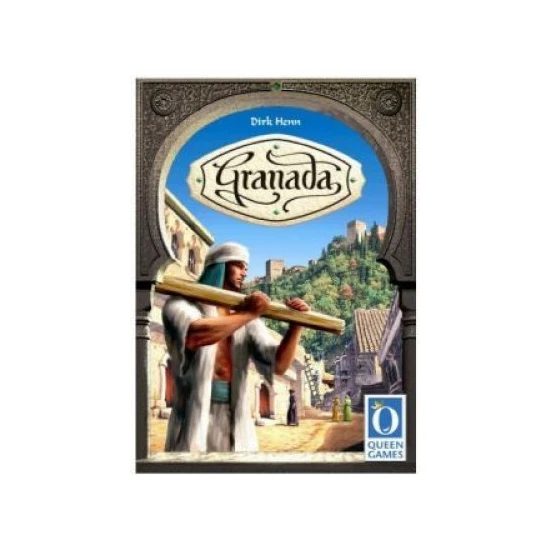
Granada
Herausgeber: Queen Games
 Möchten Sie Ihr Exemplar dieses Spiels verkaufen?

Nutzen Sie unseren Marktplatz utrade!
Granada
Kontaktieren Sie uns
Teilen auf
Der Artikel ist nicht verfügbar. Sie können die Benachrichtigung nutzen, um benachrichtigt zu werden, wenn er wieder auf Lager ist.
BILDER AUF BGG
Diese Fotos sind Eigentum von boardgamegeek.com und beziehen sich nicht speziell auf die Ausgabe auf dieser Seite.


 Kartenhüllen in diesem Spiel
110 Karten mit einer Breite von 57.0mm und einer Höhe von 89.0mm
3x
(50 Stk)

3x
(50 Stk)

2x
(100 Stk)

2x
(100 Stk)

2x
(100 Stk)
2x
(100 Stk)

1x
(110 Stk)

2x
(55 Stk)

2x
(75 Stk)

3x
(50 Stk)
2x
(75 Stk)
2x
(100 Stk)

 Beschreibung
Granada – many artisans, traders and entire families have settled at the foot of the Sierra Nevada because the Palace of Alhambra promises all people work, contracts and above all prosperity.
(From the publisher's blurb.)
Granada is new member of the Alhambra family with a more challenging character: in this standalone game the players develop the city of Granada next to Sierra Nevada, where the famous Alhambra stands, by buying building tiles to construct the city which will earn the most victory points. Building tiles now have two sides and there are new building types for which the value is set during the game.
Link to Trailer http://www.queen-games.de/index.php?id=2537----2
Play Differences from Alhambra
Alhambra advanced. Play is the same: buy a building tile, take money or remodel. If you buy a tile for the exact amount, you can take another action, same as in Alhambra. The differences: new building types, building values are dynamic, two-sided tiles, and moats instead of walls.
There are 9 building types in Granada. Unlike Alhambra, the buildings do not have a set value. Instead, building value is determined by the count of that type of building in all players' cities times a multiplier. As in Alhambra, there are 3 scoring rounds during which each building type is examined and points awarded for the player with the majority of that type of building. In the first scoring round, A, only the player with the most tiles of a particular building type scores for that building type (1 times the total count). In the second scoring round, B, the top 2 players score (2 times the total count and 1 times the total count respectively), and in the final round, the top 3 score (3x, 2x, and 1x the total count of that building type). Scoring for a "Beginners Game" is a little different.
There are no ties in Granada: points are never divided like in Alhambra. In the case of two players having the same number of tiles of a particular type in their cities, the player with the highest valued tile of that type wins, and the other player takes next place. So, in Granada, it pays to buy the more expensive buildings.
For example: When the A round-scoring card is turned up, Cindy has 2 Schools, Diana has 2, Tim has 1, Tina and Bailey each have 0, for a total of 5 Schools currently in cities. Cindy's highest School is a 10, Diana's is a 7. So, in round A, Cindy would score 1 x 5 = 5 points.
When the B round-scoring card is turned up, the count for Schools is: Cindy 2, Diana 3, Tim 1, Tina and Bailey 0 each for a total of 6 Schools. So, Diana scores 2 x 6 = 12 points and Cindy scores 1 x 6 = 6 points.
In the final round, the School count is Cindy 2, Diana 3, Tim 1, Tina 2, Bailey 0 for a total of 8 Schools in cities. Cindy's highest School is a 10, Tina's is a 4. So, Diana scores 3 x 8 = 24 points, Cindy score 2 x 8 = 16 points and Tina score 1 x 8 = 8 points.
Another difference in Granada is that the tiles are two-sided: on one side an even-numbered building of some type, on the other a different, odd-numbered building valued exactly one higher. The configuration of the buildings on both sides is identical in terms of moat placement or lack thereof on each side. When purchasing a building, a player can immediately place the building, as is, into her city or may flip it to the other side and place it in her supply for later placement during a remodel action.
The Building Market is initially filled with tiles even-side up. The next time the market is filled, the odd side will be placed up, then even, then odd, etc. A handy toggle feature is provided on the board near the Building Market to facilitate this.
The last difference between Alhambra and Granada, moats instead of walls, is really just a difference in artwork. As in Alhambra, during each scoring round, each player scores points for her longest continuous moat, instead of wall, surrounding her city. The rules are the same regarding tile placement: must be able to trace an unbroken path back to the city's center, moat can touch moat, etc. In games I've played, players have often commented that it seems to be harder to build with the moat tiles of Granada than with the wall tiles of Alhambra. Just one more way to make Granada an advanced version of Alhambra?
Re-implements:
Alhambra
 Zusätzliche Informationen
| Mechanik: | Rohstoffspekulation Sammlung festlegen Fliesenplatzierung |
| Kategorien: | Stadtgebäude Renaissance |
| Alternative Namen: | |
| BARCODE: | 4010350605714 |
| In 3__PH_1__ Wunschlisten In 4__PH_1__ Sammlungen Dies wurde 13955__PH_1__ Mal gesehen | |
Beschreibung
Granada – many artisans, traders and entire families have settled at the foot of the Sierra Nevada because the Palace of Alhambra promises all people work, contracts and above all prosperity.
(From the publisher's blurb.)
Granada is new member of the Alhambra family with a more challenging character: in this standalone game the players develop the city of Granada next to Sierra Nevada, where the famous Alhambra stands, by buying building tiles to construct the city which will earn the most victory points. Building tiles now have two sides and there are new building types for which the value is set during the game.
Link to Trailer http://www.queen-games.de/index.php?id=2537----2
Play Differences from Alhambra
Alhambra advanced. Play is the same: buy a building tile, take money or remodel. If you buy a tile for the exact amount, you can take another action, same as in Alhambra. The differences: new building types, building values are dynamic, two-sided tiles, and moats instead of walls.
There are 9 building types in Granada. Unlike Alhambra, the buildings do not have a set value. Instead, building value is determined by the count of that type of building in all players' cities times a multiplier. As in Alhambra, there are 3 scoring rounds during which each building type is examined and points awarded for the player with the majority of that type of building. In the first scoring round, A, only the player with the most tiles of a particular building type scores for that building type (1 times the total count). In the second scoring round, B, the top 2 players score (2 times the total count and 1 times the total count respectively), and in the final round, the top 3 score (3x, 2x, and 1x the total count of that building type). Scoring for a "Beginners Game" is a little different.
There are no ties in Granada: points are never divided like in Alhambra. In the case of two players having the same number of tiles of a particular type in their cities, the player with the highest valued tile of that type wins, and the other player takes next place. So, in Granada, it pays to buy the more expensive buildings.
For example: When the A round-scoring card is turned up, Cindy has 2 Schools, Diana has 2, Tim has 1, Tina and Bailey each have 0, for a total of 5 Schools currently in cities. Cindy's highest School is a 10, Diana's is a 7. So, in round A, Cindy would score 1 x 5 = 5 points.
When the B round-scoring card is turned up, the count for Schools is: Cindy 2, Diana 3, Tim 1, Tina and Bailey 0 each for a total of 6 Schools. So, Diana scores 2 x 6 = 12 points and Cindy scores 1 x 6 = 6 points.
In the final round, the School count is Cindy 2, Diana 3, Tim 1, Tina 2, Bailey 0 for a total of 8 Schools in cities. Cindy's highest School is a 10, Tina's is a 4. So, Diana scores 3 x 8 = 24 points, Cindy score 2 x 8 = 16 points and Tina score 1 x 8 = 8 points.
Another difference in Granada is that the tiles are two-sided: on one side an even-numbered building of some type, on the other a different, odd-numbered building valued exactly one higher. The configuration of the buildings on both sides is identical in terms of moat placement or lack thereof on each side. When purchasing a building, a player can immediately place the building, as is, into her city or may flip it to the other side and place it in her supply for later placement during a remodel action.
The Building Market is initially filled with tiles even-side up. The next time the market is filled, the odd side will be placed up, then even, then odd, etc. A handy toggle feature is provided on the board near the Building Market to facilitate this.
The last difference between Alhambra and Granada, moats instead of walls, is really just a difference in artwork. As in Alhambra, during each scoring round, each player scores points for her longest continuous moat, instead of wall, surrounding her city. The rules are the same regarding tile placement: must be able to trace an unbroken path back to the city's center, moat can touch moat, etc. In games I've played, players have often commented that it seems to be harder to build with the moat tiles of Granada than with the wall tiles of Alhambra. Just one more way to make Granada an advanced version of Alhambra?
Re-implements:
Alhambra
Kartenhüllen in diesem Spiel
110 Karten mit einer Breite von 57.0mm und einer Höhe von 89.0mm
3x
(50 Stk)
3x
(50 Stk)
2x
(100 Stk)
2x
(100 Stk)
2x
(100 Stk)
2x
(100 Stk)
1x
(110 Stk)
2x
(55 Stk)
2x
(75 Stk)
3x
(50 Stk)
2x
(75 Stk)
2x
(100 Stk)
Zusätzliche Informationen
| Mechanik: | Rohstoffspekulation Sammlung festlegen Fliesenplatzierung |
| Kategorien: | Stadtgebäude Renaissance |
| Alternative Namen: | |
| BARCODE: | 4010350605714 |
| In 3__PH_1__ Wunschlisten In 4__PH_1__ Sammlungen Dies wurde 13955__PH_1__ Mal gesehen | |

VORSICHT! Nicht für Kinder unter 3 Jahren geeignet. Es enthält Kleinteile, die verschluckt oder eingeatmet werden können.