


 (+39) 320 073 4588
 SKONTAKTUJ SIĘ Z NAMI PRZEZ E-MAIL













|
|
|

2
Niezależny od języka
|
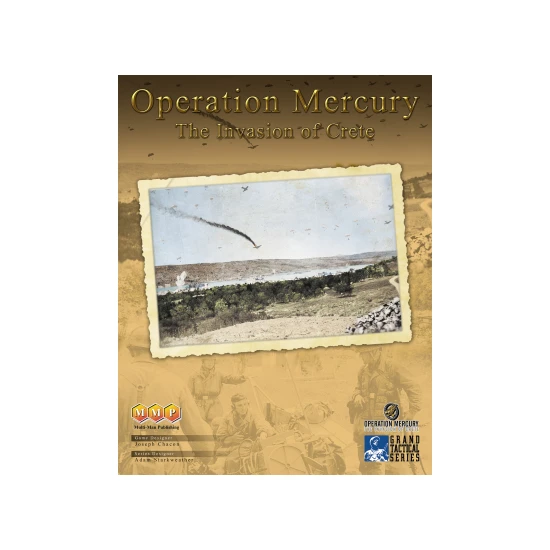
Operation Mercury: The Invasion of Crete
Wydawca: Multi-Man Publishing
 Czy chcesz sprzedać swój egzemplarz tej gry?

Skorzystaj z naszego rynku utrade!
Operation Mercury: The Invasion of Crete
Skontaktuj się z nami
udostępnij
Artykuł nie jest dostępny. Możesz skorzystać z naszego systemu powiadomień e-mailowych, aby dowiedzieć się, kiedy będzie można go ponownie zamówić.
ZDJĘCIA NA BGG
bggpicszastrzeżenie


 Opis
Opis
From the publisher:
Early in the morning on 20 May 1941, as 30,000 Commonwealth soldiers on Crete were finishing breakfast, hundreds of German transport aircraft—some towing gliders—rumbled over the Mediterranean island. The air above was suddenly filled with parachutes as thousands of elite German paratroops—Fallschirmjäger—descended from the sky.
The invasion of Crete was one of the most dramatic battles of the Second World War. Over a nine-day period in May 1941, a mixed force of Commonwealth and Greek troops desperately tried to fight off the German assault. Despite appalling casualties, the paratroopers and glider-borne troops managed to secure a foothold and the critical Maleme Airfield to open the door for the German Gebirgsjäger (mountain troops) to land under fire. Together the Fallschirmjäger and Gebirgsjäger pushed the Commonwealth troops to their breaking point and forced a deadly battle of delay and pursuit.
This was a true soldier’s battle, with both sides in desperate situations often lacking higher-level control and support. The Germans had to quickly secure a usable airfield or face the annihilation of their entire airborne force. The Commonwealth needed to crush the German landings or—failing that—evacuate the bulk of its forces to continue the fight in North Africa and Syria.
The German invasion of Crete in May 1941 stands as a landmark in the history of airborne warfare. Up until that point, airborne operations were tactical operations to seize key objectives in advance of the ground forces. The German invasion of Crete (codenamed Operation Merkur) was the first strategic airborne operation.
Although casualties would mean Crete was the last hurrah for the German airborne in a major air assault, it set the stage for even larger future Allied airborne operations in the Mediterranean, Western Europe, and Asia.
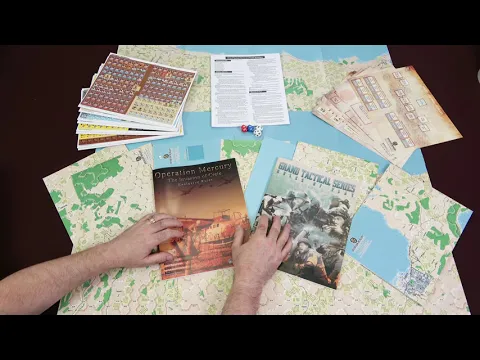
Operation Mercury maintains the same level of detail and scale as other Grand Tactical Series (GTS) games. Players command divisions and maneuver company-sized units to fight one of the most desperate battles of the war. Using the GTS 2.0 rules, Operation Mercury offers two players or teams a wide range of scenarios ranging from a single small map with a few units on each side to the full battle including up to two German divisions and several Commonwealth and Greek brigades. Operation Mercury covers all the major airdrops and fighting across the island from Heraklion in the east, through Rethymnon, and from Maleme to Suda Bay then south to the Askifou Plain, scene of the last major fight during the withdrawal.
As the Commander of Allied forces on Crete, can you deny the Germans a precious airfield and negate their much-needed air-landing reinforcements for a quick victory? Of all operations of war, a withdrawal under heavy enemy pressure is probably the most difficult and perilous. Can you get the bulk of your forces to the southern evacuation ports? As the German, how quickly can you force the collapse of the Commonwealth morale and trigger their withdrawal?
Features include:
Shifting Allied morale state based on relative casualties and key events, which can trigger evacuation and end-game victory conditions.
Random events, including tank breakdowns, misdirected airstrikes, and partisan attacks.
An option for Commonwealth naval support at the risk of losing precious ships to German air attacks.
Thirteen scenarios include:
Separate one-map battles for the airdrops at Rethymnon, Heraklion, and the Maleme/Canea sector.
A one-map battle for the New Zealand counter-attack to retake Maleme airfield.
One-, two-, and three-map battles for the difficult German advance and Commonwealth delay and withdrawal.
The full campaign on all five maps or just the main event from Maleme to Askifou Plain on three maps.
Hypothetical German precision drops as well as a German free drop scenario.
 Dalsze informacje
| Mechanika: | Łowienie na ślepo Rzut kostką Oznaczenia i siatka sześciokątna |
| Kategorie: | Wojna Wojna |
| Alternatywne nazwy: | |
| BARCODE: | ????????? |
| W kolekcjach 1__TOK_1__ Obejrzano go 2235__TOK_1__ razy | |
Opis
From the publisher:
Early in the morning on 20 May 1941, as 30,000 Commonwealth soldiers on Crete were finishing breakfast, hundreds of German transport aircraft—some towing gliders—rumbled over the Mediterranean island. The air above was suddenly filled with parachutes as thousands of elite German paratroops—Fallschirmjäger—descended from the sky.
The invasion of Crete was one of the most dramatic battles of the Second World War. Over a nine-day period in May 1941, a mixed force of Commonwealth and Greek troops desperately tried to fight off the German assault. Despite appalling casualties, the paratroopers and glider-borne troops managed to secure a foothold and the critical Maleme Airfield to open the door for the German Gebirgsjäger (mountain troops) to land under fire. Together the Fallschirmjäger and Gebirgsjäger pushed the Commonwealth troops to their breaking point and forced a deadly battle of delay and pursuit.
This was a true soldier’s battle, with both sides in desperate situations often lacking higher-level control and support. The Germans had to quickly secure a usable airfield or face the annihilation of their entire airborne force. The Commonwealth needed to crush the German landings or—failing that—evacuate the bulk of its forces to continue the fight in North Africa and Syria.
The German invasion of Crete in May 1941 stands as a landmark in the history of airborne warfare. Up until that point, airborne operations were tactical operations to seize key objectives in advance of the ground forces. The German invasion of Crete (codenamed Operation Merkur) was the first strategic airborne operation.
Although casualties would mean Crete was the last hurrah for the German airborne in a major air assault, it set the stage for even larger future Allied airborne operations in the Mediterranean, Western Europe, and Asia.
Operation Mercury maintains the same level of detail and scale as other Grand Tactical Series (GTS) games. Players command divisions and maneuver company-sized units to fight one of the most desperate battles of the war. Using the GTS 2.0 rules, Operation Mercury offers two players or teams a wide range of scenarios ranging from a single small map with a few units on each side to the full battle including up to two German divisions and several Commonwealth and Greek brigades. Operation Mercury covers all the major airdrops and fighting across the island from Heraklion in the east, through Rethymnon, and from Maleme to Suda Bay then south to the Askifou Plain, scene of the last major fight during the withdrawal.
As the Commander of Allied forces on Crete, can you deny the Germans a precious airfield and negate their much-needed air-landing reinforcements for a quick victory? Of all operations of war, a withdrawal under heavy enemy pressure is probably the most difficult and perilous. Can you get the bulk of your forces to the southern evacuation ports? As the German, how quickly can you force the collapse of the Commonwealth morale and trigger their withdrawal?
Features include:
Shifting Allied morale state based on relative casualties and key events, which can trigger evacuation and end-game victory conditions.
Random events, including tank breakdowns, misdirected airstrikes, and partisan attacks.
An option for Commonwealth naval support at the risk of losing precious ships to German air attacks.
Thirteen scenarios include:
Separate one-map battles for the airdrops at Rethymnon, Heraklion, and the Maleme/Canea sector.
A one-map battle for the New Zealand counter-attack to retake Maleme airfield.
One-, two-, and three-map battles for the difficult German advance and Commonwealth delay and withdrawal.
The full campaign on all five maps or just the main event from Maleme to Askifou Plain on three maps.
Hypothetical German precision drops as well as a German free drop scenario.
Dalsze informacje
| Mechanika: | Łowienie na ślepo Rzut kostką Oznaczenia i siatka sześciokątna |
| Kategorie: | Wojna Wojna |
| Alternatywne nazwy: | |
| BARCODE: | ????????? |
| W kolekcjach 1__TOK_1__ Obejrzano go 2235__TOK_1__ razy | |

UWAGA! Nie nadaje się dla dzieci poniżej 3 roku życia. Zawiera małe części, które mogą zostać połknięte lub wdychane.